
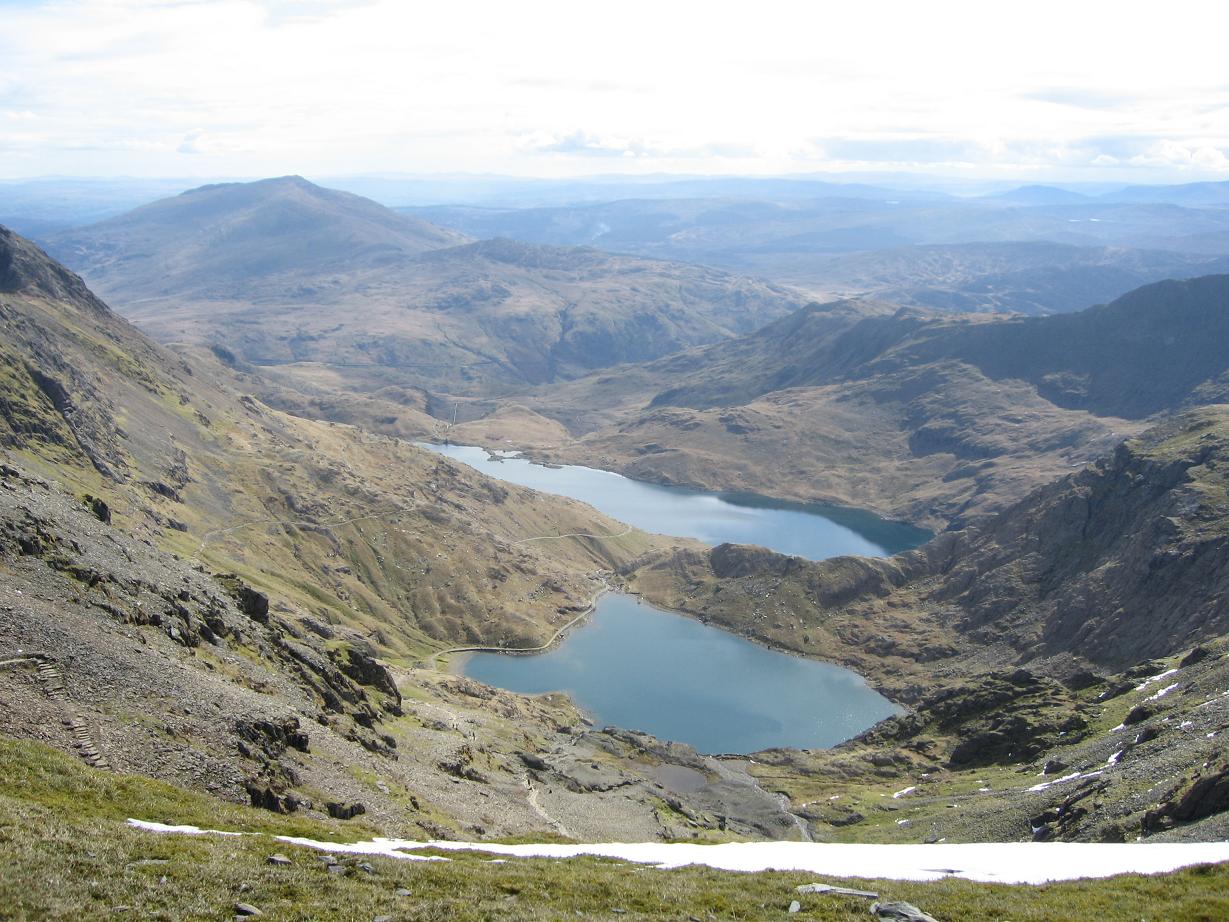
The landscape of Eryri carries more mythology per square mile than almost anywhere in Britain. Specific mountains, lakes, rocks, and passes are named in and by the stories — the myths are geographically precise in a way that rootless legends rarely are. This is not fairy tale: it's a form of knowledge about the landscape, accumulated over centuries and attached to the places that generated it.
Dinas Emrys — The Two Dragons
The rocky hill of Dinas Emrys, above Beddgelert in Nantgwynant (SH 606 492, accessible by footpath from the valley), is one of the most mythologically charged sites in Wales. According to the Historia Brittonum (9th century CE), the British king Vortigern attempted to build a fortress on this hill — but each morning, the work of the previous day had collapsed into the ground. His wise men told him to find a boy with no father and use his blood to stabilise the foundations.
The boy found was Myrddin (Merlin), who revealed that beneath the hill lay a pool, and in the pool two sleeping dragons — one red, one white — the very same dragons buried there earlier in the tale of Lludd and Llefelys, one of the eleven tales of Y Mabinogion. When the pool was drained, the dragons awoke and fought: the white dragon (representing the Anglo-Saxon invaders) initially prevailed, but then the red dragon (representing the native Britons) turned the battle. Merlin interpreted this as a prophecy of ultimate Welsh victory. The red dragon of Wales on the national flag derives from this story. Archaeological excavations at Dinas Emrys in the 1950s confirmed occupation of the site in the 5th and 6th centuries CE — in the period when the Vortigern legend is set. A pool was found on the summit platform.
Gelert — The Fabricated Legend
Beddgelert means "grave of Gelert." The village maintains a gravestone south of the village marking the burial place of Gelert, the faithful hound of Llywelyn ap Iorwerth. The story: Llywelyn returns from hunting to find his infant son's cradle overturned and the hound Gelert covered in blood. Concluding that the dog has killed the child, he drives his sword through it. Too late, he discovers the infant unharmed beneath the cradle, and beside it the body of a wolf that Gelert had killed to protect the child.
This is one of the most moving stories in Welsh tradition. It is almost certainly a fabrication — invented around 1800 by David Pritchard, the landlord of the Royal Goat Hotel in Beddgelert, to attract tourists to the village. The grave was constructed by Pritchard; the story was circulated in printed form and became an instant success. The tale itself is a version of an ancient international folk story (Aarne-Thompson-Uther tale type 178A — the faithful animal unjustly slain) found in multiple cultures from India to Iceland. What makes the Beddgelert case remarkable is not the fabrication but the self-awareness it's possible to bring to it: the village maintains the "grave" with full knowledge of its recent origin, and most Welsh-speaking visitors are aware of Pritchard's role.
The Afanc of Llyn Tegid
Llyn Tegid (Bala Lake) is said to be home to the Afanc — a water monster of uncertain form (sometimes described as beaver-like, sometimes crocodilian) that lurked in the depths and caused catastrophic floods. The Afanc was eventually removed from the lake by Hu Gadarn using two enormous oxen, who dragged it out and carried it to the mountains — typically identified as Glaslyn beneath Yr Wyddfa, where it was confined. The story connects two of the most significant bodies of water in Eryri in a mythological narrative that also functions as an explanation of why the lake floods and why the small mountain lake beneath the summit looks so different from a normal moorland tarn.
Arthur and Yr Wyddfa
Arthur is said to have fought his penultimate battle — against the giant Rhita Gawr, who collected kings' beards for his cloak — on the summit of Yr Wyddfa, and to have buried Rhita there, giving the mountain its Welsh name (Yr Wyddfa = the great tomb or burial mound). Arthur's own sleeping place is a cave beneath the summit, where he and his warriors await the hour of Wales's greatest need. Bwlch y Saethau — "pass of the arrows," between Yr Wyddfa and Y Lliwedd — is identified as the site of Arthur's final battle, where he was mortally wounded by treachery. The knights who carried him away are said to have thrown their arrows into Glaslyn below — hence the pass's name.
The Tylwyth Teg — The Welsh Fairies
The Tylwyth Teg (the Fair Family) are the Welsh equivalent of the fairy folk — neither the benevolent Tinkerbell variety nor the genuinely malevolent spirits of Irish tradition, but something in between: beautiful, capricious, given to stealing children (replacing them with changelings), and accessible under specific conditions. High mountain lakes are particularly associated with Tylwyth Teg activity; the lakes above the treeline in Eryri were understood as gateways to their underground realm. The story of the physician of Myddfai — a farmer who marries a Lady of the Lake — is one of the most fully developed Tylwyth Teg narratives in Wales.
Independently written — Snowdon.com